Scar Architecture: How Things Stand in Present Day Bucharest
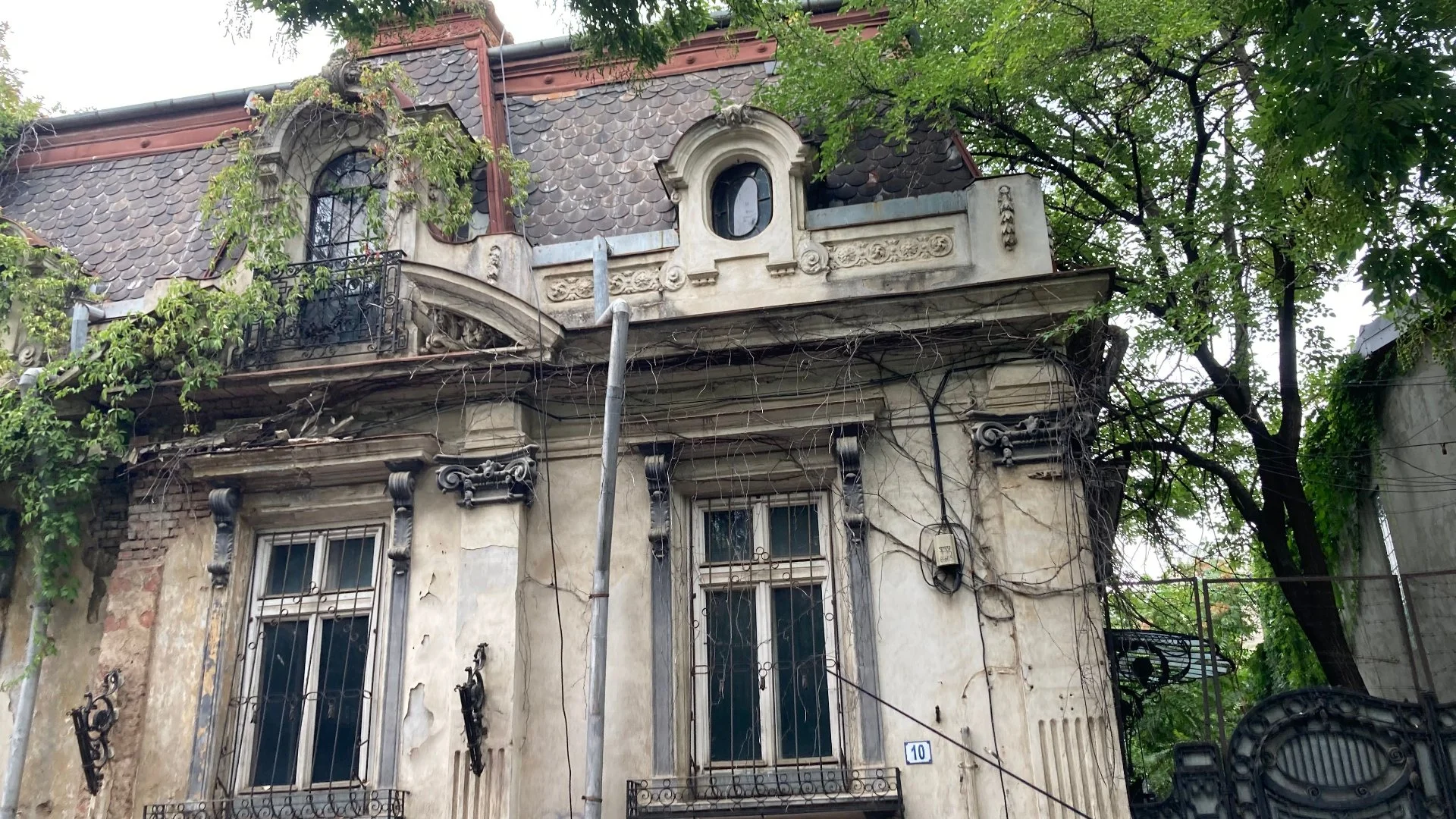
10 Theodor Aman Street, Bucharest, Romania
Let us indulge in that most unfashionable of pastimes, i.e., analysing the architecture of a place and thereby figuring out whether the society that built it deserves praise or scorn, and, more importantly, whether those who came after managed to maintain it or left the beautiful walls to graffiti and the trees to climb onto the buildings, much like it happened in the Bucharester “microrayons”. I call this phenomenon Scar Architecture, after the Chinese literary movement that appeared once the Cultural Revolution was over and its survivors were finally permitted to describe it.
Upon arrival at Gara de Nord (North Station), the main railway terminus of București (Bucharest), one is immediately struck by the decadent façade of this neoclassical building, its majestic columns unbearably dirty and covered in tagging, not to mention the many questionable dwellers inside and out. It was a station built to receive soldiers, deportees, the rural surplus of industrialisation simply deposited in this capital city, and nowadays those who sleep in the underpass. Walk out and those very same dispositions extend for kilometres, nineteenth-century apartment blocks with their stucco coming off, a prefabricated tower dropped mid-street, a church stranded at the wrong angle to the road and really none of it coalescing into a period, because what you will find is not merely the promised vistas of communist yore; these are, in fact, the remnants of every government that used Bucharest as its architectural laboratory. The condition is shared with other European capitals (Berlin above all, where Wilhelmine stock sits alongside everything that came after), though Bucharest holds at its heart a stranger, more powerful cool, as yet unexplored and probably destined to remain so. There are grand buildings enough, sure, like the Ateneul Român (Romanian Athenaeum), the Muzeul Național de Artă (National Museum of Art) in the Palatul Regal (Royal Palace), and a central area that is on the whole clean-cut, featuring even some modern bastardisations of the International Style. Traipsing around these streets and peering where others dare not or know not how to, the reality is much different.
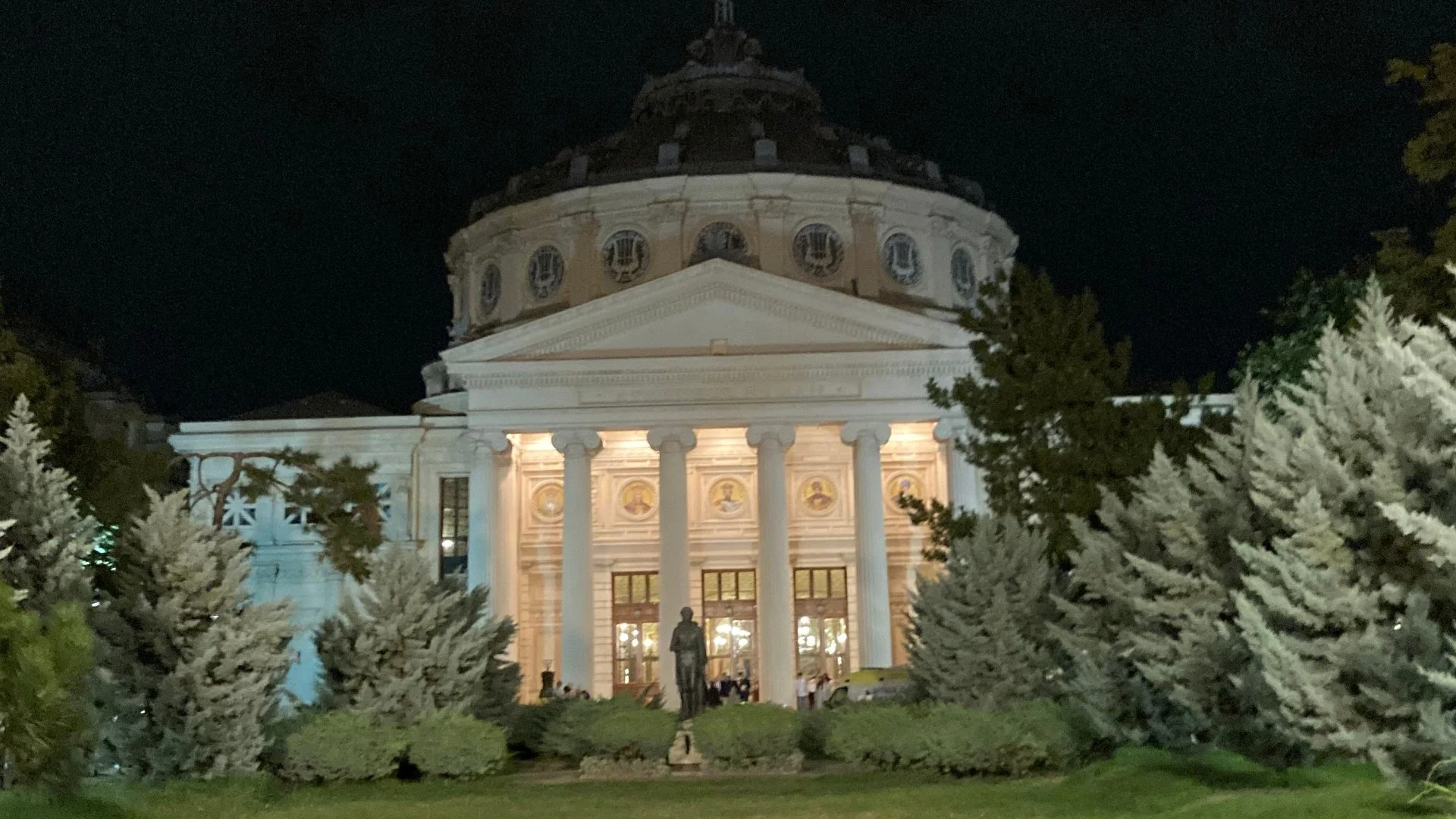
Romanian Athenaeum
The overall rundownness of the modernist buildings along Bulevardul Nicolae Bălcescu and Bulevardul General Gheorghe Magheru, a five-minute walk from all that, is where Bucharest starts drawing in unbeknownst passersbys to its mysteries, its manifold tags from some eurotrash artist, or closed hatmakers in Parisian-style passageways. A propos: the city earned its nickname, Paris of the East, presumably from those Haussmannian avenues, due to a French-educated elite which set about importing boulevards, axial perspectives and formal squares. While Calea Victoriei (the Way of Victory) hosted the evening promenade, the outer quarters had unpaved streets, no sanitation and rural housing; truly Balkanic.
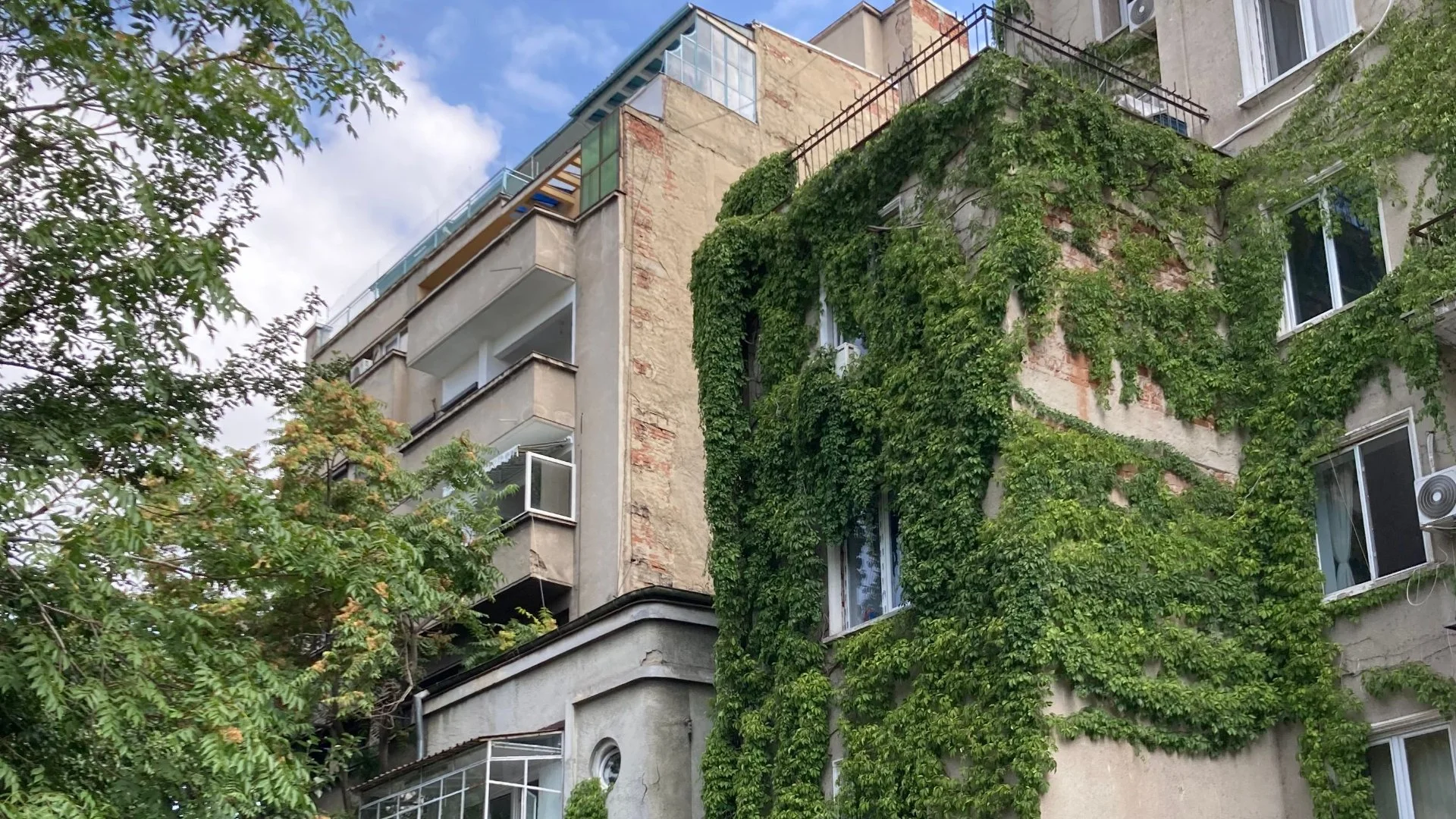
Residential buildings partially covered by vine, Bucharest, Romania
Bulevardul Magheru running north from Piața Universității (University Square) to Piața Romană (Roman Square) is one of the most complete interwar modernist streetscapes in Europe, all geometric façades, rounded corners and Streamline Moderne detailing, with Horia Creangă’s ARO building as its anchor, and Marcel Iancu (known abroad as Janco), who had co-founded Dada at the Cabaret Voltaire, putting up apartment blocks along this axis. All of which is now the most photogenic decay in Bucharest and quite close to where I stayed. In any case, what might present itself as neglect I later found out is more akin to a sort of management stall among proprietors, since restitution returned these buildings to scattered co-heirs and there was no cadastre to establish who owned what. The graffiti and the ailanthus are, then, downstream of a property problem. When it comes to the socialist period, it arrived in two waves: the first has as my favourite example the Casa Scânteii (House of the Spark, after the party daily Scânteia), a Stalinist wedding cake at reduced scale, a copy of Moscow State University, the tallest building in Bucharest until 2007, planted at the head of a boulevard named after a Russian military administrator of the city. It remains the only building still carrying hammer, sickle and red star carved into its façade medallions, having been renamed, after 1990, Casa Presei Libere (House of the Free Press) and filled with the offices of newspapers. The second wave brought the microrayon (microraion in Romanian), the Soviet planning unit imported wholesale: a cluster of blocks housing four to twelve thousand people, provisioned with its own food and clothing shops, library, clinic and sports ground, so that daily life could be conducted without leaving it, with schools and playgrounds below that scale and cinemas, hospitals and theatres above it. The estate at Drumul Taberei (Camp Road), built from the early sixties on the former army training ground that gave it the name, in the south-west, is the one that worked: four to ten storeys, wide planted space between the blocks, a cinema, a swimming pool, a park. Berceni, in the south, shows the reverse inside the same system, its first stage green and reasonably spaced, its western half from 1971 exclusively prefabricated panel, denser and shoved together.
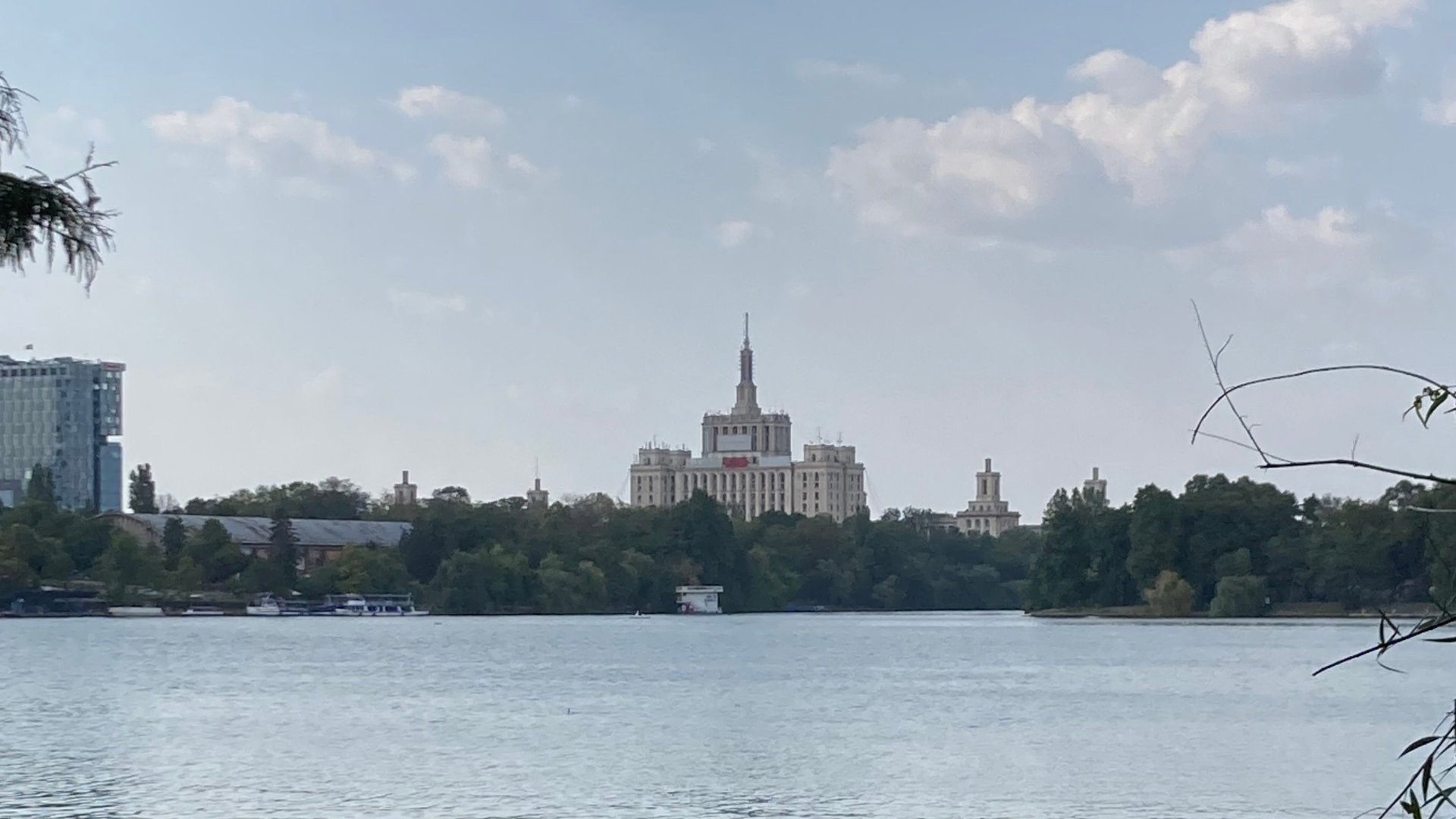
House of the Free Press as seen from King Michael I Park
And then, about the Palatul Parlamentului (Palace of the Parliament, which Romanians still call Casa Poporului, the House of the People), that colossus everyone photographs stands on a levelled hill. The hill was Uranus, a dense old quarter south-west of the centre, and from 1981 it came down: ten thousand homes, tens of thousands of people, some of them evicted on a day's notice, twenty churches destroyed or dragged elsewhere, one monastery rolled away on rails and hidden behind apartment blocks. A fifth of the historic centre in the end, replaced by the Centrul Civic (Civic Centre), an administrative quarter modelled on Pyongyang whose boulevard was specified to exceed the Champs-Élysées in length and width. For this transformation Romanians coined the word “Ceaușima”, meaning Ceaușescu + Hiroshima.
5 Nicolae Iorga Street, Bucharest, Romania
Piața Constituției (Constitution Square) is where all this ended up. The square spreads flat and enormous in front of the Palace of the Parliament and meanwhile the Centrul Vechi (Old Town) was restored into nightlife scenography. Nearly four decades on, nothing has been repaired nor absorbed. The graffitis keep popping as much as the trees continue to climb up the buildings and surely it will remain that way for many decades. They will outlive us and showcase how much buildings get hurt too, in the midst of all these regime changes.